Ultralytics YOLO27:
Masks, keypoints, rotated boxes, and class labels — labeled, trained, turned into numbers, and shipped
Practitioner pathwayintermediate ~5 hours 10 lessons Final exam · Certificate

Beyond Detection: Segment, Pose, OBB, and Classify

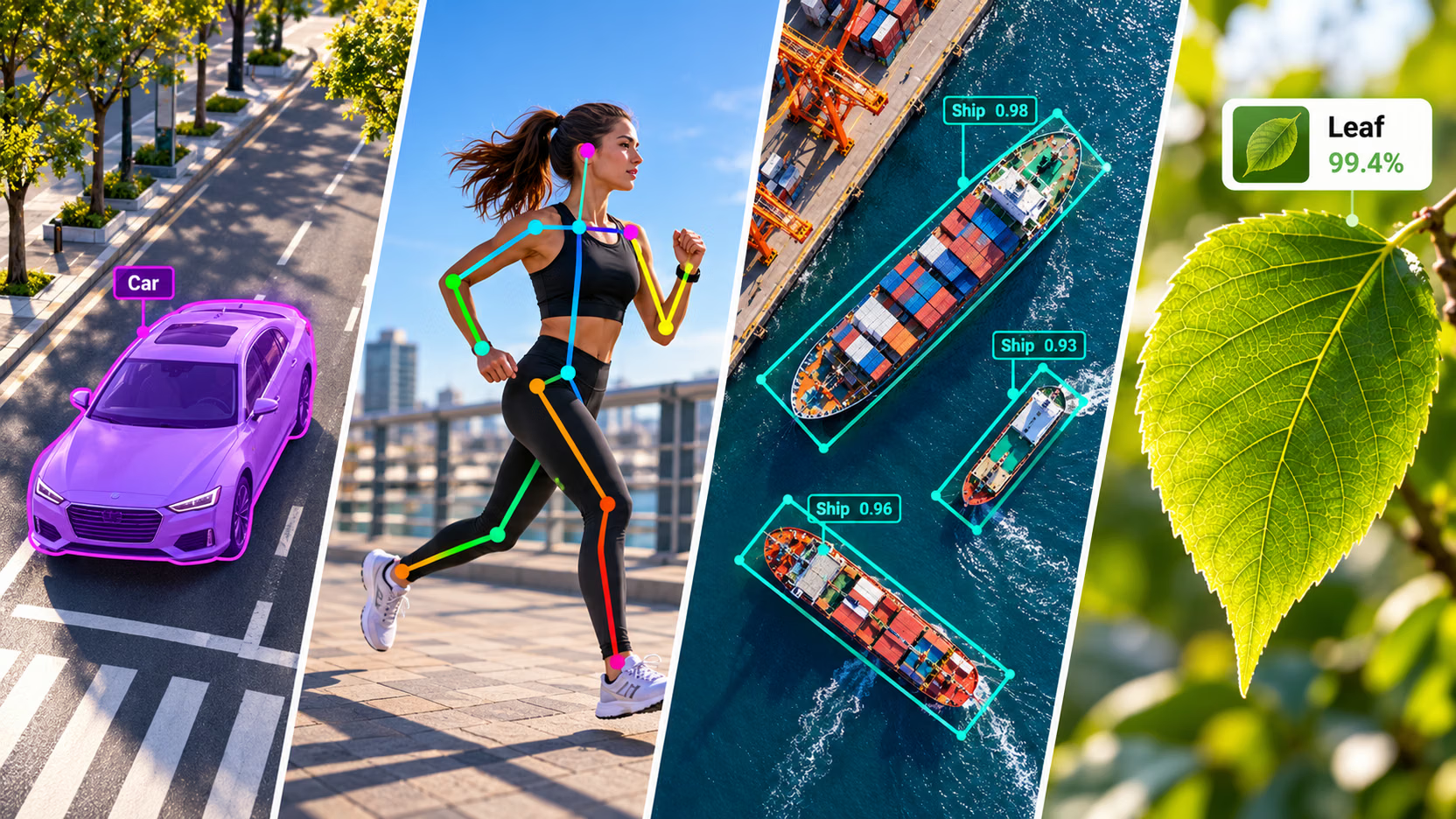
You can train a detector. Ultralytics YOLO supports seven vision tasks, and this course teaches the five you will meet most often after detection — instance and semantic segmentation, pose, oriented bounding boxes, and classification — from label format and training to reading results in code, chaining models, and per-task evaluation and export. Depth estimation, the seventh task, is part of the task plan and the evaluation and export lessons.

What you'll learn

Choose the right Ultralytics YOLO26 task for a product question, then label, train, read, evaluate, and export segmentation, semantic, pose, OBB, and classification models, and chain them into pipelines that answer questions a detector cannot.

  • Map a product question to one of the seven Ultralytics YOLO tasks, its weights, its result field, and its gating metric.

  • Write and check polygon, PNG class-map, keypoint, four-corner OBB, and folder-layout datasets before training.

  • Train -seg, -sem, -pose, -obb, and -cls models and read mask mAP, mIoU, OKS-based pose mAP, rotated-box mAP, and top-1 accuracy.

  • Turn predictions into decisions: mask areas and overlaps, class-map coverage, joint angles, ship headings, and confidence-routed labels.

  • Chain tasks (detect then classify, pose plus tracking), keep their cost flat, and export every task to ONNX with a verified prediction.

What you'll build
  • A task plan that names the task, weights, label format, result field, and gating metric for each model in a pipeline.

  • Label checkers for segmentation and pose datasets that catch malformed rows before a GPU hour is spent.

  • One-epoch training runs for segmentation, semantic segmentation, pose, OBB, and classification, with each metric explained.

  • Scripts that measure mask area and overlap, walkable surface, elbow and knee angles, and ship axes from real predictions.

  • A two-stage pipeline that classifies each tracked person once, and ONNX exports of every task, each verified with a prediction.

Prerequisites
  • Complete Train your first YOLO model — this course assumes you can train, validate, and predict with a detector.

  • Comfortable with Python and NumPy arrays.

  • A GPU helps but is not required: every example runs on a laptop CPU at epochs=1 and a small imgsz.

Course content

4 modules · 10 lessons