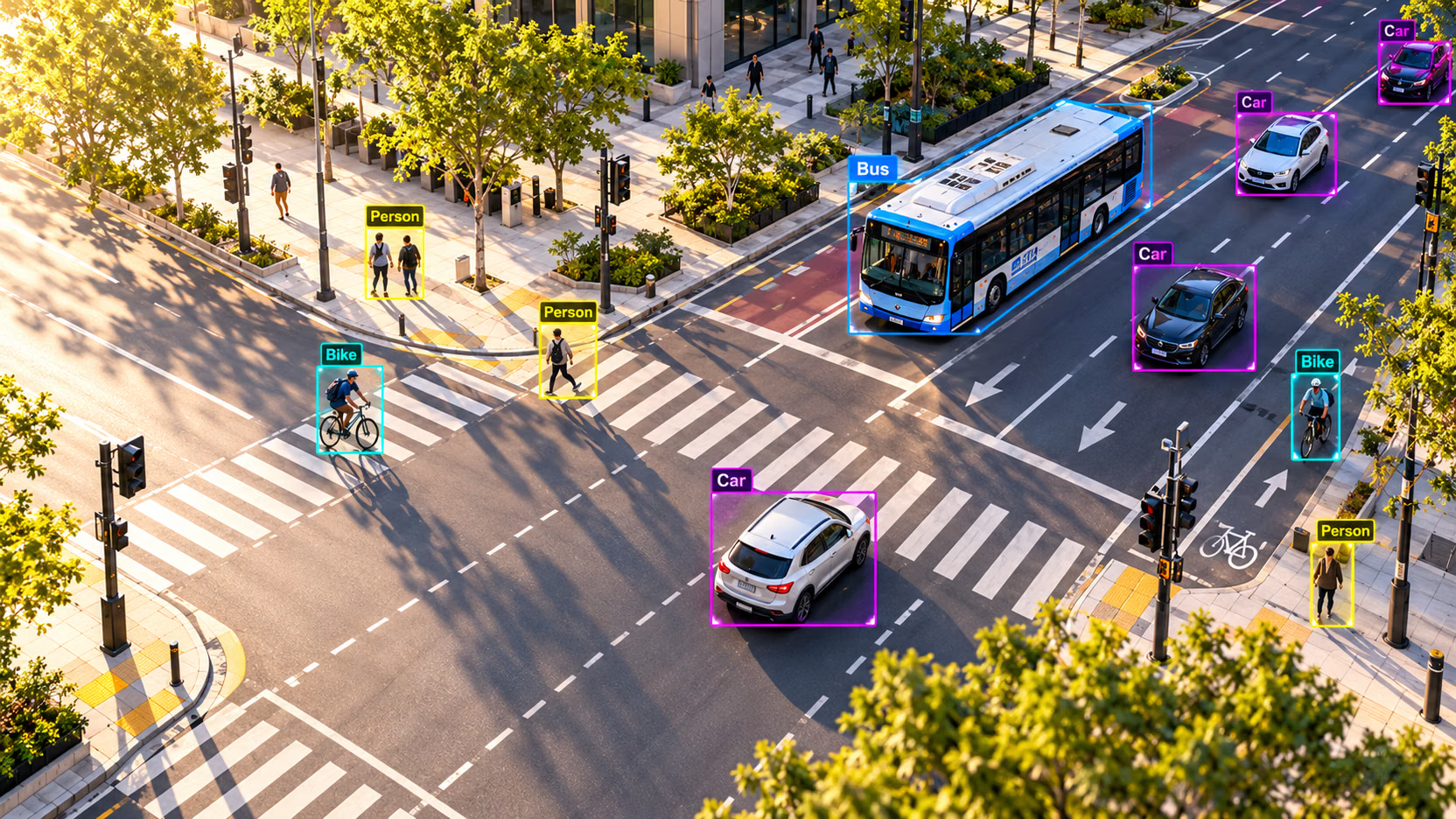
Computer Vision Foundations
Learn the judgment behind every working vision system — framing the task, choosing among the seven Ultralytics YOLO tasks, auditing data and labels, splitting honestly, and reading metrics — with runnable YOLO26 examples on real images and datasets.
By Ultralytics Academy
Frame a computer vision problem, choose the right task and labels, check that your data matches reality, and know what "good" looks like before you train.
Turn a product idea into a three-line task spec, and keep business rules in code instead of in the model.
Match an output to the right one of seven tasks: classification, detection, instance segmentation, semantic segmentation, depth estimation, pose, or OBB.
Read detector output and set confidence and IoU thresholds from the cost of each mistake.
Audit a real dataset for coverage gaps, broken labels, and near-duplicate images that leak across splits.
Read precision, recall, mAP50-95, per-class AP, and the confusion matrix together to decide ship, iterate, or rethink.
A task spec for your project, with a decision rule written as code on top of YOLO26 output.
A dataset audit and label check for a real dataset, with a ranked collection plan.
A leak check and a group split that keep near-identical images out of validation.
An evaluation read-out that names the bottleneck class and the shipping threshold.
A first YOLO26 run on your own images, checked against your spec.
No prior computer vision experience — the concepts stand on their own.
Optional but recommended: Python 3.10+ and
pip install ultralyticsto run the examples. Everything runs on a laptop CPU in seconds.
Course content
4 modules · 10 lessonsModule 1
Module 2
The Seven Vision Tasks
Map an output line to classification, detection, instance segmentation, semantic segmentation, depth estimation, pose, or OBB, and pick the YOLO26 weights to start with.
Understand Object Detection
Read a detector's output — class, box, confidence — and set the confidence and IoU thresholds from the cost of each mistake.
Boxes vs Masks: When You Actually Need Segmentation
Measure what a mask adds over a box on a real image, and decide from the downstream consumer whether your project needs shape at all.
Pose Estimation and OBB
Read keypoints and rotated boxes from YOLO26, write a rule on top of each, and recognize when posture or angle is the real signal.
Module 3
Datasets that Reflect Reality
Audit a real dataset for coverage gaps before you label more, and turn the gaps into a collection plan with hard negatives.
Annotation Quality
Know what a YOLO label contains, lint label files for broken rows, and keep annotators consistent with a guideline and a measured calibration round.
Module 4
Splits that Tell the Truth
Find near-duplicate images that leak across train and validation, and split by the unit that will be new at deployment.
Reading Detection Metrics Honestly
Run validation, read precision, recall, mAP50-95, per-class AP, and the confusion matrix together, and pick a shipping threshold from a target.
From Lab to Production
Install Ultralytics, run YOLO26 on your own images, check the output against your spec, and choose your next step.