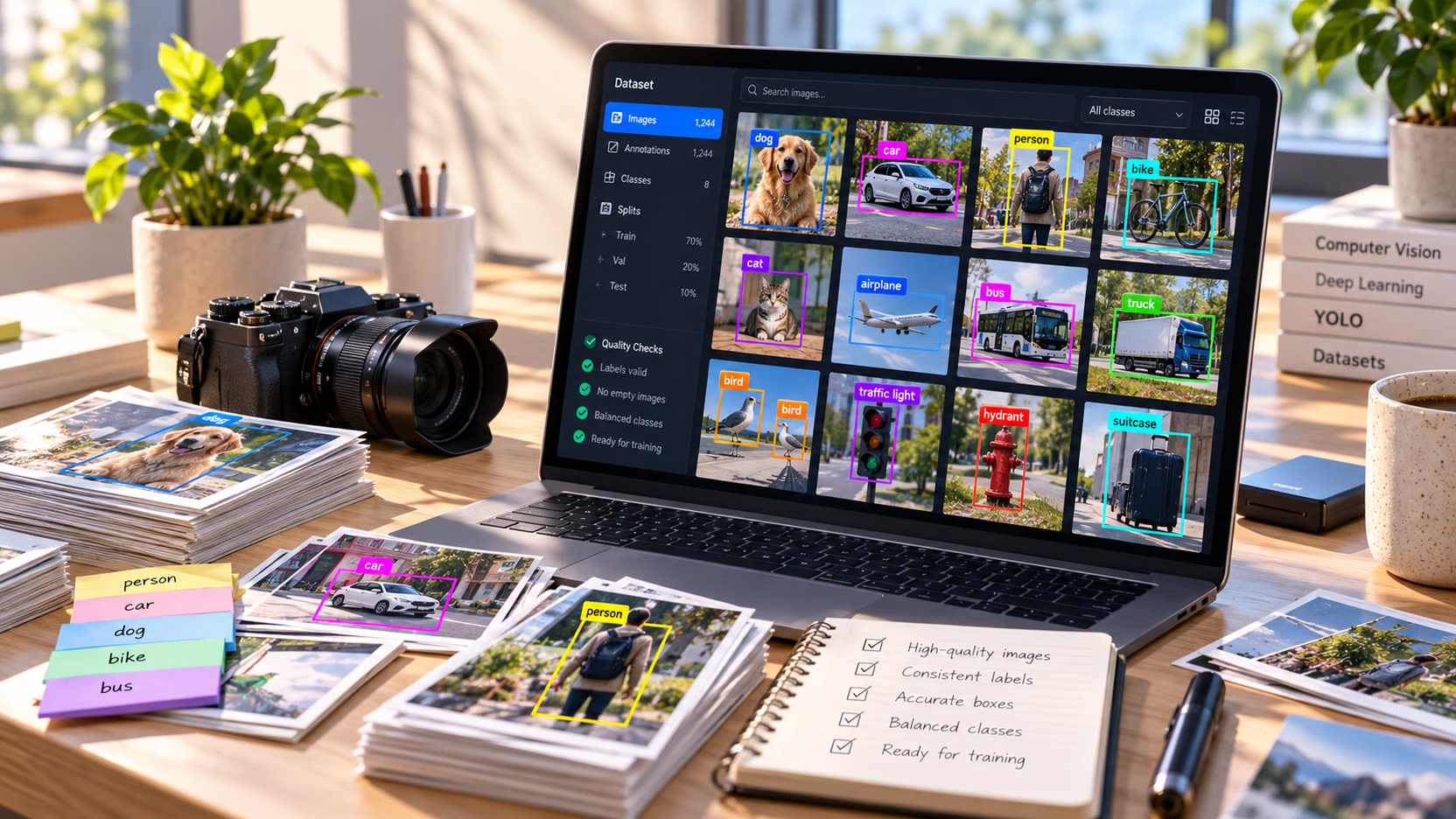
Building High-Performance YOLO Datasets
A hands-on playbook for the work before training: turn a business goal into an acceptance test, specify and collect representative data, label consistently, audit quality with scripts, split without leakage, tune augmentation, and gate the first Ultralytics YOLO26 fine-tune on a readiness check.
By Ultralytics Academy
Turn a business objective into a documented, balanced, leak-free dataset that is ready to fine-tune Ultralytics YOLO26 on, and know exactly what to fix when it is not ready yet.
Turn a business goal into a vision task, defined classes, and an acceptance test you can run as code.
Write a dataset specification with scenario quotas, sized against Ultralytics' targets: ≥1,500 images and ≥10,000 labeled instances per class, 0–10% background images.
Collect from real deployment conditions, keep capture metadata in filenames, and sample video without flooding the dataset.
Label consistently with a written guide, a measured calibration round, and the ten most common annotation mistakes in mind.
Audit labels, class balance, duplicates, and likely missing labels with short Python scripts.
Split by group (clip, camera, day, site) so validation scores reflect production, and lock the test set.
Choose augmentation settings that match deployment and verify them in training batches.
Gate training on an eight-item readiness check and turn a baseline fine-tune into the next dataset fix.
A one-page objective and an acceptance test script that prints PASS or FAIL.
A dataset specification with scenario quotas, edge cases, and a background share.
A practice dataset with capture metadata in every filename, plus a coverage report against your quotas.
A labeling guide refined by a calibration round with a measured agreement score.
A QC audit and suspect-label review with short QC notes.
Grouped train / val / test file lists with no clip, camera, or day shared across splits.
A scored readiness check, a first fine-tune ranked by class, and a reusable kickoff checklist.
No machine-learning background required: every concept is explained before it is used.
Python 3.10+ with
pip install ultralyticsto run the scripts; a CPU is enough for every example.Recommended: Computer Vision Foundations for the core vocabulary.
Course content
5 modules · 10 lessonsModule 1
Start With the Business Objective
Turn a business goal into a vision task, defined classes, and an acceptance test you can run as code, before a single image is collected.
Define the Dataset Specification
Plan scenarios, quotas, variance, edge cases, and background images before collection, and size the plan against Ultralytics' volume targets.
Module 3
Annotation Best Practices
Write a labeling guide, choose a tool, avoid the ten mistakes that quietly cost accuracy, and measure annotator agreement with a script before scaling.
Dataset Quality Control
Audit labels, class balance, duplicates, and split coverage with a script, let a model point at likely missing labels, and fix what you find before training.
Module 4
Split the Dataset Correctly
Measure how random splits leak, split whole groups such as clips, cameras, or days with a script, check class coverage, and lock the test set.
Use Augmentation Carefully
Test every augmentation against the deployment camera, build a justified profile, train with it, and check the result in training batches.
Module 5
Know When the Dataset Is Ready
Gate the first training run on eight pass/fail checks, automate the three a script can verify, and know which fix each failure calls for.
First Fine-Tune and the Iteration Loop
Fine-tune pretrained YOLO26 weights with defaults, rank classes by AP with miss and confusion counts, and turn the weakest class into the next dataset fix.
Enterprise Client Checklist
A one-page, customer-facing kickoff checklist that captures every dataset decision before collection and gates each retrain.